AI Agency
Borrow the tool — don't outsource the thinking
You can now say "write me ten lines of Python to score the sentiment of these comments" — and ten seconds later you have ten working lines.
The question this course cares about isn't can the machine write the code. It plainly can. It's the one you'll answer about every line it hands you:
Do you understand it well enough to judge it?

The promise is real
Be fair to the tool first. AI-assisted coding genuinely lowers the barrier:
- act without having memorized every function
- spend your energy on the question instead of the syntax
- build in an afternoon what used to take a semester
This is not cheating, and it isn't new in spirit — programmers have borrowed from manuals, colleagues, and Stack Overflow for decades.
You'll lean on VADER, pandas, and Gensim all term.
The risk is also real
The danger isn't borrowing — it's borrowing what you can't read. Code you didn't write and can't explain is a black box:
"It runs on my test data… but will it hold on real data?
I can't tell — I don't actually know what it does."
When the box breaks — and it will — you're stuck. You can't debug what you never understood.
The risk is also real
Subtler is the quiet failure: pseudo-agency.
You feel powerful — "I built this!" — while becoming more dependent, unable to modify, maintain, or vouch for the thing with your name on it.
And you can't weigh the biases baked into the tool — whose data trained it, what it quietly treats as normal — if you take its output as a given.
Scaffold, not replacement
So the line isn't "AI or no AI." It's scaffold vs. replacement.
- Scaffold — the AI handles boilerplate; you hold the research question, the definitions, the interpretation, and you can explain, test, and extend every line. You come out understanding more.
- Replacement — paste a prompt, paste the answer, submit. You come out understanding nothing, and the AI has spoken for you.
Scaffold, not replacement
That's the gap between two literacies: one that can adapt, debug, and critique what it borrows, and one that can only copy and paste.
The course's rule follows directly — and it's in your syllabus:
You must be able to explain any code you submit, and note in a #comment where AI helped and what you changed.
Learning a language vs. letting someone speak for you
Learning a language means you know what each piece does, you can adapt it to a new situation, and you can fix it when it breaks.
The other thing — output that runs but that you can't explain, adapt, or repair — is ventriloquism:
the words come out of your mouth, but someone else is choosing them.
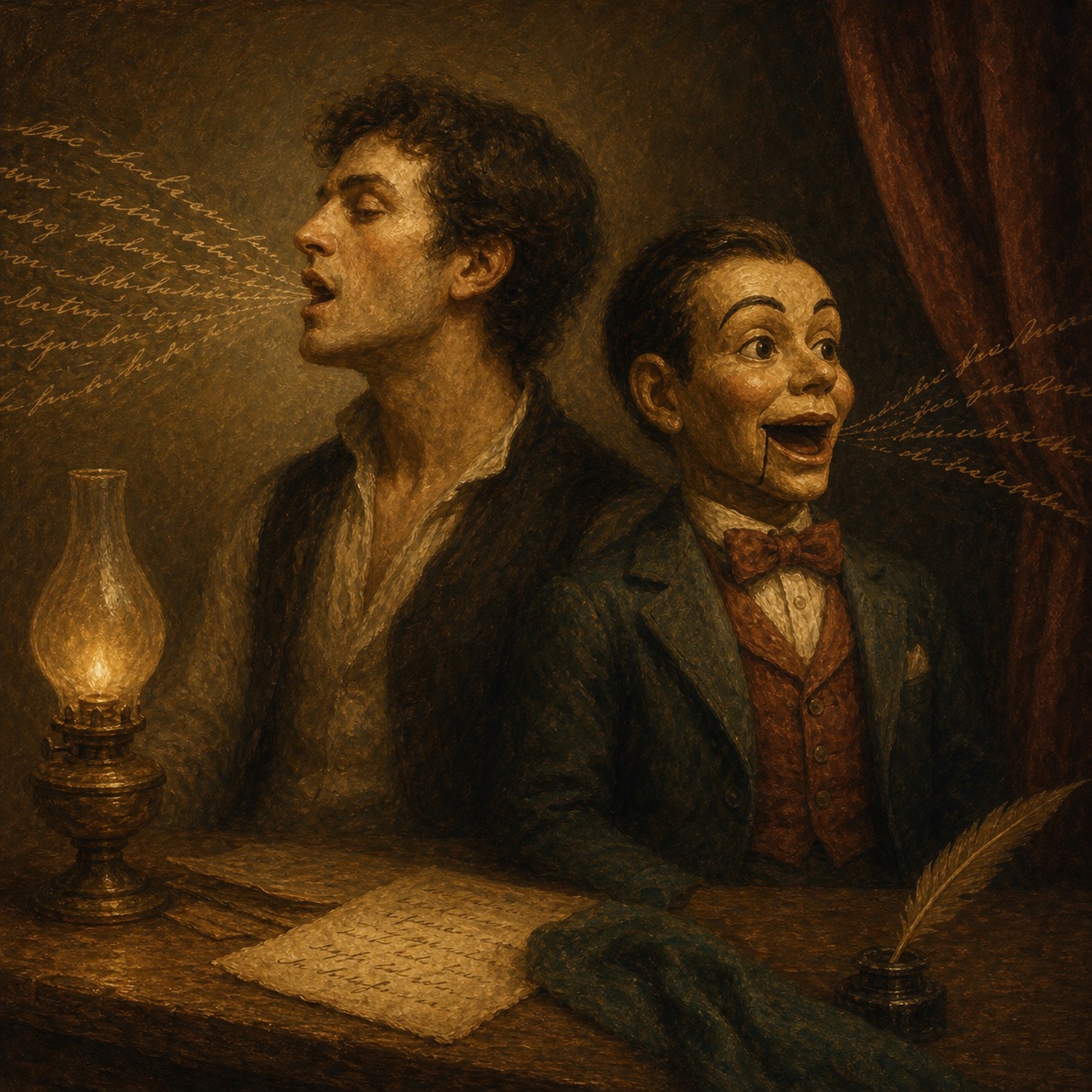
Learning a language vs. letting someone speak for you
Here is where coding and writing meet, and where the rule flips.
Nobody's voice lives in a stopword list, so borrow the tool freely — understand it, judge it, move on.
But your reflections, your discussion posts, and your capstone essay are your voice — and a voice is forged only in the friction of finding your own words.
Learning a language vs. letting someone speak for you
Let an AI write your code and you've saved time. Let it write your prose and you've handed away the one thing this course exists to grow.
Borrow the tool; never outsource the voice — and know which is which.
Ted Chiang calls a language model "a blurry JPEG of the web." A voice worth having is the opposite of an average.
Eloquence is not evidence
One more property of the machine's writing: it is fluent — confident, structured, grammatically flawless — whether it is right or wrong.
For a long time, polished prose was expensive: producing it usually meant someone had done real work. Language models broke that rough correlation. Fluency is now free, and it reads exactly the same when the claim is true and when it is invented.
Eloquence is not evidence
Our instincts haven't updated: a well-made paragraph still feels vetted before any judgment has convened.
Colbert popularized a word for that feeling — truthiness, when something feels true from the gut before the evidence arrives.
An AI is a machine for making anything feel gut-true.
Eloquence is not evidence
Philosophy has a blunter word. Frankfurt distinguished the liar — who knows the truth and conceals it — from the bullshitter, who simply doesn't care what's true, only what lands.
Some philosophers argue "hallucination" is the wrong name for AI errors: a hallucination implies a mind mistaking false for true, but a model has no regard for truth at all.
On that argument, an LLM is a bullshit engine in Frankfurt's strict sense, even when it happens to be right.
Eloquence is not evidence
None of this is new; only the machinery is. In Plato's dialogue Gorgias, the rhetorician Gorgias boasts that a skilled speaker would beat the physician in a debate about medicine, before an audience that knew no medicine. (Gorgias 456b–c, 459a–b)
Because eloquence feels like expertise from the inside.
Eloquence is not evidence
Greek had a word for what settles into a person who gets their beliefs that way: amathia.
In this course's reading of it: not ignorance — agnoia, which more information fixes — but un-wisdom: the condition of the well-informed, well-assisted person whom nothing any longer teaches.
Remember the Day-1 diagram? Amathia is the shadow at its bottom-right corner: knowledge that never becomes wisdom, because the labor between them got outsourced.
Eloquence is not evidence
Two things to carry out of that word.
First, it points at us, never at them. Not a diagnosis you hand to the commenters in our data — it's the temptation you face every time an eloquent answer arrives faster than your judgment.
Second, the fix is not an attitude. Attitudes don't beat gut-level habits. The fix is procedural friction: run the code, check the citation, find the source, read the seams.
Right next to the score is never the meaning: eloquence is not evidence.
Today: read the seams
That's exactly today's lab. You'll take a chunk of AI-written code, read it line by line, and improve it — practicing the judgment that turns borrowing into understanding.
Then we plant the stylometry seed: reading for the seams between human and machine writing — the tells of a voice that was averaged into being versus one that was lived into being.
Today: read the seams
The kind of code an AI hands you
def count_words(text):
    counts = {}
    for word in text.split():
        counts[word] = counts.get(word, 0) + 1
    return counts
It runs. It looks finished. Now read it. What is word on each pass? What does .get(word, 0) do? (You haven't seen it yet. Find out.) Are "Commandments" and "commandments," one word or two?
Today: read the seams
You understand code when you can:
- say what each line takes in and hands back
- name the type of each important variable
- predict what an unusual input will do
- name one thing it gets wrong
- change one thing, and test that the change worked
The syllabus asks this of anything you borrow: explain it, and note in your #comments where AI helped and what you changed.
Today: read the seams
Carry one question out of here:
Are you learning to think computationally, or just outsourcing the thinking?
The same tool allows either. The difference is whether you can still explain, judge, and own what you made — and whether the words are finally yours.
As always: make the choice visible. Cite the AI, and say what you changed.