Connotations & Code
Why no number is ever neutral
The opening lecture left us with a claim: every arrow in the pipeline from a lived human fact to an "insight" is a human choice. This lecture turns that claim on the very first thing you'll touch — a plain number — and asks what it can, and can't, tell us on its own.
Here is a fact about the corpus we'll work with all term: 93 YouTube comments on a Texas law that puts the Ten Commandments in public-school classrooms. (A corpus is simply a collection of texts gathered for analysis.) The comments sit under one CBS News video from August 20, 2025, reporting that a federal judge had blocked the law in some school districts, and they were copied within the following month using a browser scraping tool. So many of them are reacting to the judge as much as to the law. The tool caught top-level comments but not the replies under them, and blank and duplicate entries were removed. Some comments are tiny: one reads, in full, "Of Texas." And one more choice shapes everything you'll compute: a few long comments ran over several lines, and the cleaning split them at their line breaks. So the file you'll load has 123 rows, not 93, and some rows are only pieces of a comment. The export kept no names or dates, either, so we don't know how many people wrote these comments, or exactly when. They are not a sample of Texans, or even of YouTube: they're whoever chose to comment on that one video, and whatever the tool caught. We'll come back to who that leaves out.
What does the count say?
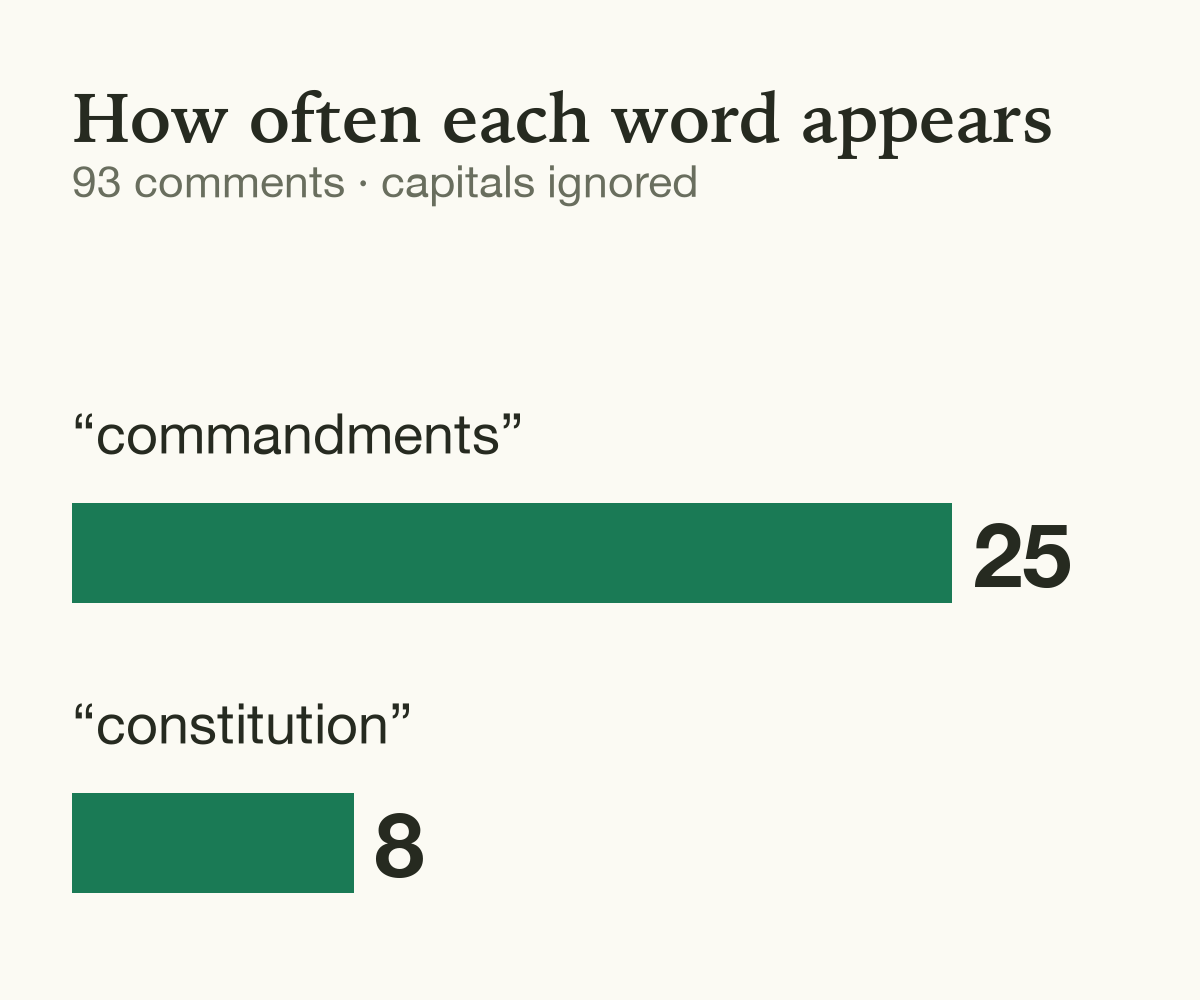
In those 93 comments, ignoring capitals, the word "commandments" appears 25 times. "Constitution" appears 8.
A flat, true, countable fact. It's tempting to read it at once — the crowd cares more about scripture than law. But list what else could explain it. The video is about the Ten Commandments, so the word was always going to dominate. Count with capitals and "Constitution" falls to 4. And the comments come only from people who chose to post. Before we run a single line of code, ask the humanist's question: what could this number mean, what else could explain it, and who decided what got counted?
Denotation and connotation

You already own the tool this lecture needs — you've used it on words your whole life.
- A word's denotation is what it literally points to. House, home, and residence denote the same thing: a building people live in.
- Its connotation is everything it carries on top of that — warmth, money, bureaucracy, belonging. Home and residence denote alike and connote worlds apart.
Now the move that makes you a data humanist: numbers have connotation too. "Single-mother household" denotes a category on a form; it connotes a whole contested story about blame and worth, and which story you hear depends on who's speaking. The denotation is the surface. The connotation is where the culture lives — and where the argument is.
The myth of neutral data

Three comforting things people say about data. Each one is too simple.
- "Data doesn't lie." — It doesn't have to lie to mislead. It can simply leave things out.
- "The numbers speak for themselves." — Numbers never speak for themselves. Someone always speaks for them, by choosing the frame.
- "It's just objective analysis." — Every dataset is a record of somebody's choices about what was worth counting, and what wasn't.
Data carries the values, assumptions, and blind spots of whoever collected, sorted, and counted it. That isn't a flaw you can scrub out. It's the opening lecture's diagram again: every arrow there was a choice, and so is every column here. A dataset is a record of choices before it is a record of anything else.
Same numbers, three stories

Two plain numbers:
School A — average SAT 1240. School B — average SAT 980.
Watch the same denotation spin into three different connotations, each one quietly handing the blame to someone else:
- Deficit story — School B's students are underperforming. (It's the kids.)
- Systemic story — School B is under-resourced and underfunded. (It's the system.)
- Cultural story — the SAT measures one particular kind of knowledge. (It's the test.)
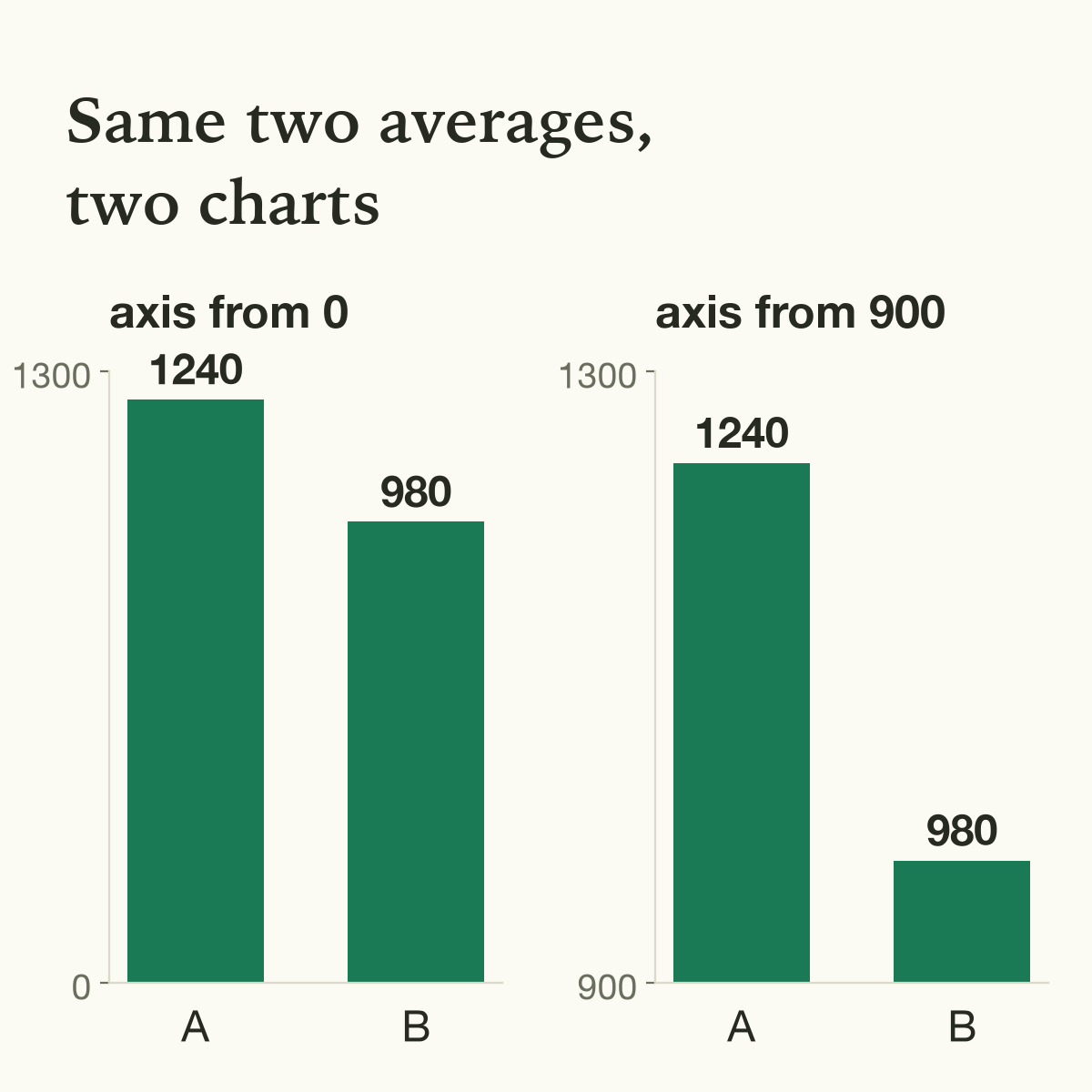
Nothing in the numbers tells you which story is true. They show a difference, not its cause; to argue about causes, you'd need more evidence than the two scores. Even the difference can be staged: draw the same two bars with the axis starting at 900 instead of 0, and School B seems to collapse. The numbers are the easy part. Choosing the story is the human part — and it is already an argument about fairness, wearing the costume of arithmetic.
Who's doing the telling?

If numbers don't tell their own story, someone does — usually someone with power over the frame.
- Institutions define the categories: a government writes the census boxes, a university decides what "success" counts as, a platform decides what "engagement" means.
- Media sets the frame: the headline, the axis a chart starts at, the context that gets cut for space.
- Researchers choose the question: what gets studied, who gets sampled, and who paid for the asking.
So the reflex this course wants to build: every time a number lands in front of you, ask who collected this, why, and whose story does it tell?
The missing and the uncounted

The loudest thing about a dataset is often what isn't in it.
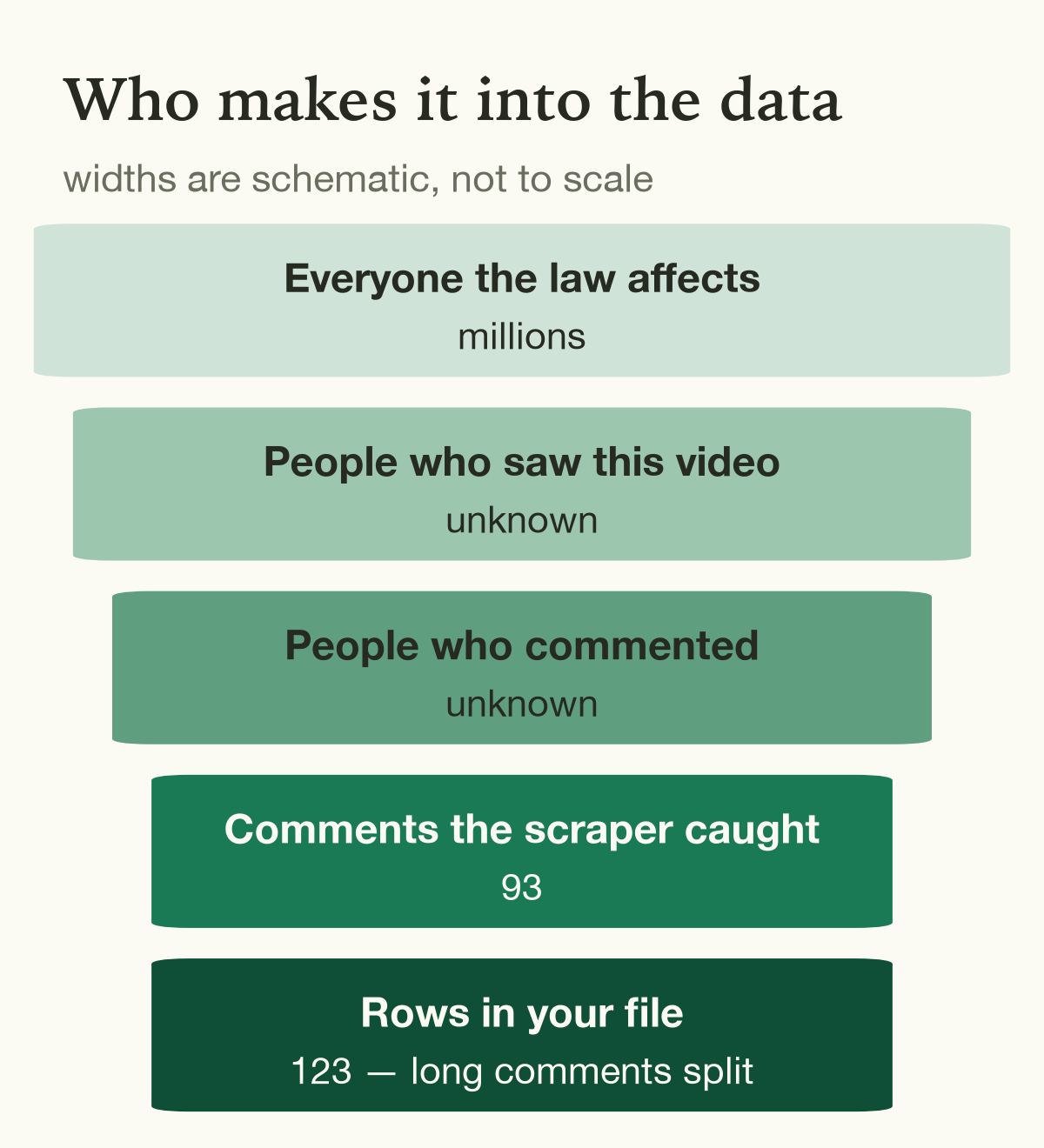
Our 93 comments are not "the public." They're the slice of the public that posted — people online, fired up enough to type, willing to be seen arguing. The woman from the opening lecture posted. Her neighbor, who felt just as strongly and never typed a word, is not in the file at all. Neither is anyone without the wifi, the time, or the nerve.
Absence from the data is not absence from reality. Some of the most important voices in any cultural question are exactly the ones the counting never reaches. A good distant reading stays honest about the silence at its edges.
So: code is not neutral

Code inherits every connotation above — and then adds its own, because code runs on definitions, and a definition is a decision.
Over the next eight weeks you will be the one deciding. What counts as a "word" when you split a comment? Which words are "stopwords" worth deleting? What score makes a comment "positive"? Where do you cut one topic from the next? Each is a small act of interpretation that looks like a neutral function.
In code, those decisions are concrete operations. You'll split text into words, count them, delete the ones on a stopword list (common words like the and of that an analyst chooses to skip), score each comment and set a threshold (a cutoff that turns a continuous score into a category like "positive"), and group comments that use similar words. Every one of those verbs hides a choice.
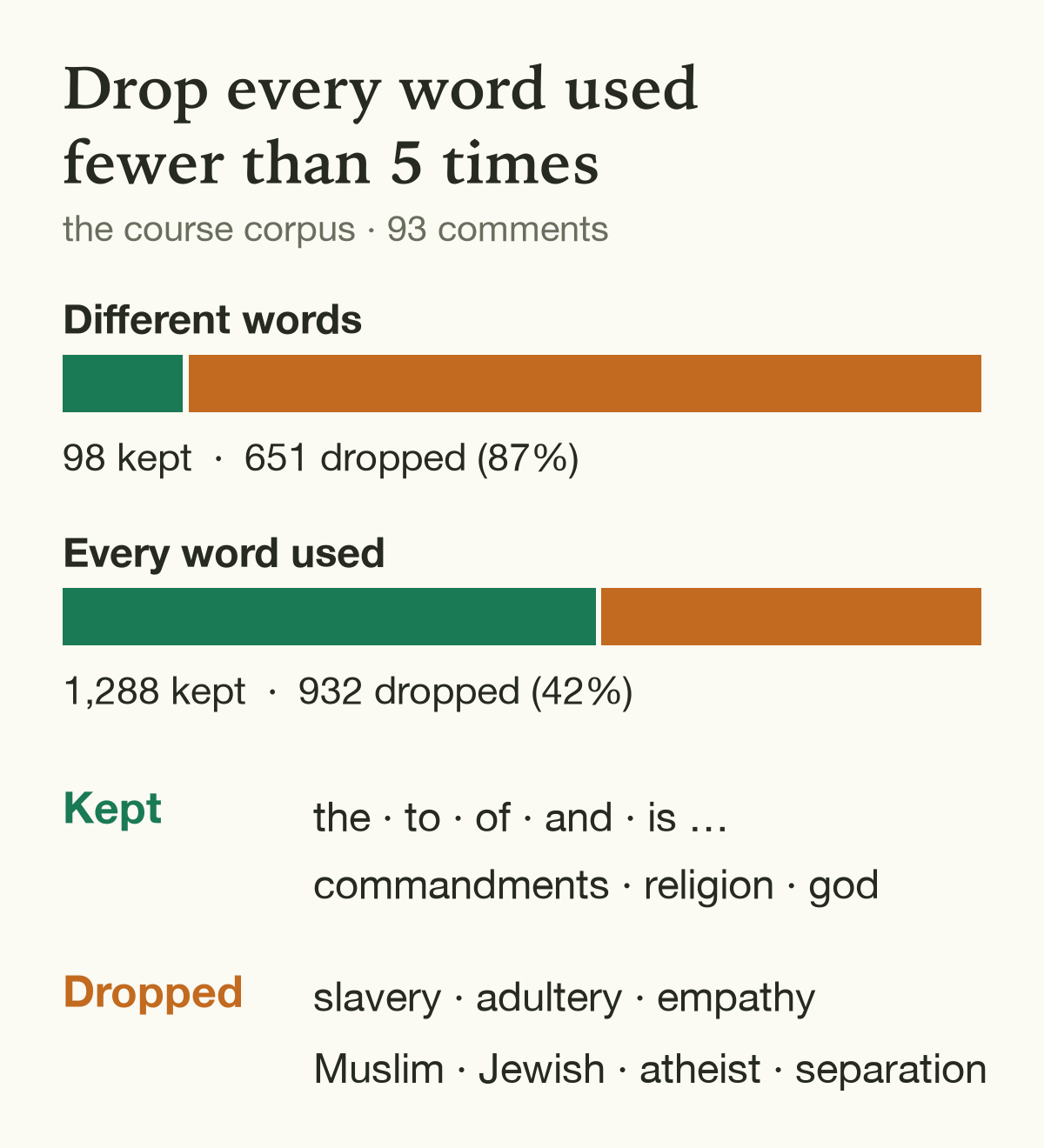
And those choices don't merely encode a value — they argue one. Which number you make the headline, which chart you reach for, what you put first and what you bury: every one is a claim about what matters, aimed at whoever reads your result. If your code drops every word that appears fewer than five times, it has made a claim: that rare words are less useful, or less meaningful. In our file, that rule deletes 651 of the 749 different words — slavery, adultery, empathy, Muslim, and Jewish among them — while keeping the, to, and of. Code isn't only structure; it's rhetoric. You'll feel that fully when you go public with an analysis at the end of the term — but it starts here, in the smallest function.
That's the trap and the responsibility at once: a machine looks objective precisely because it hides the choices inside it. Your job as a humanist who codes is the double move from the opening lecture — read data like a text, and write code that shows its choices. Leave the #comment that says what you chose, and why. That comment is not housekeeping. It's where the honesty shows.